Understanding people.
Improving work.
I'm Camryn Cooper, an I/O Psychology and human capital professional exploring how people experience work—and how evidence can inform better workforce decisions.
Evercrest Services Group
2026 Employee Pulse Study — Evaluating employee experience trends and retention intentions across three survey waves.
From workforce questions to organizational recommendations
This end-to-end study examines changes in leadership trust, employee experiences in higher-pressure departments, and workplace factors associated with Intent to Stay. I analyzed a synthetic longitudinal workforce dataset, developed an executive dashboard, and translated the results into practical recommendations.
The project demonstrates survey analysis, nonparametric testing, multiple regression, exploratory factor analysis, statistical interpretation, and executive reporting. Results are illustrative and do not describe a real employer.
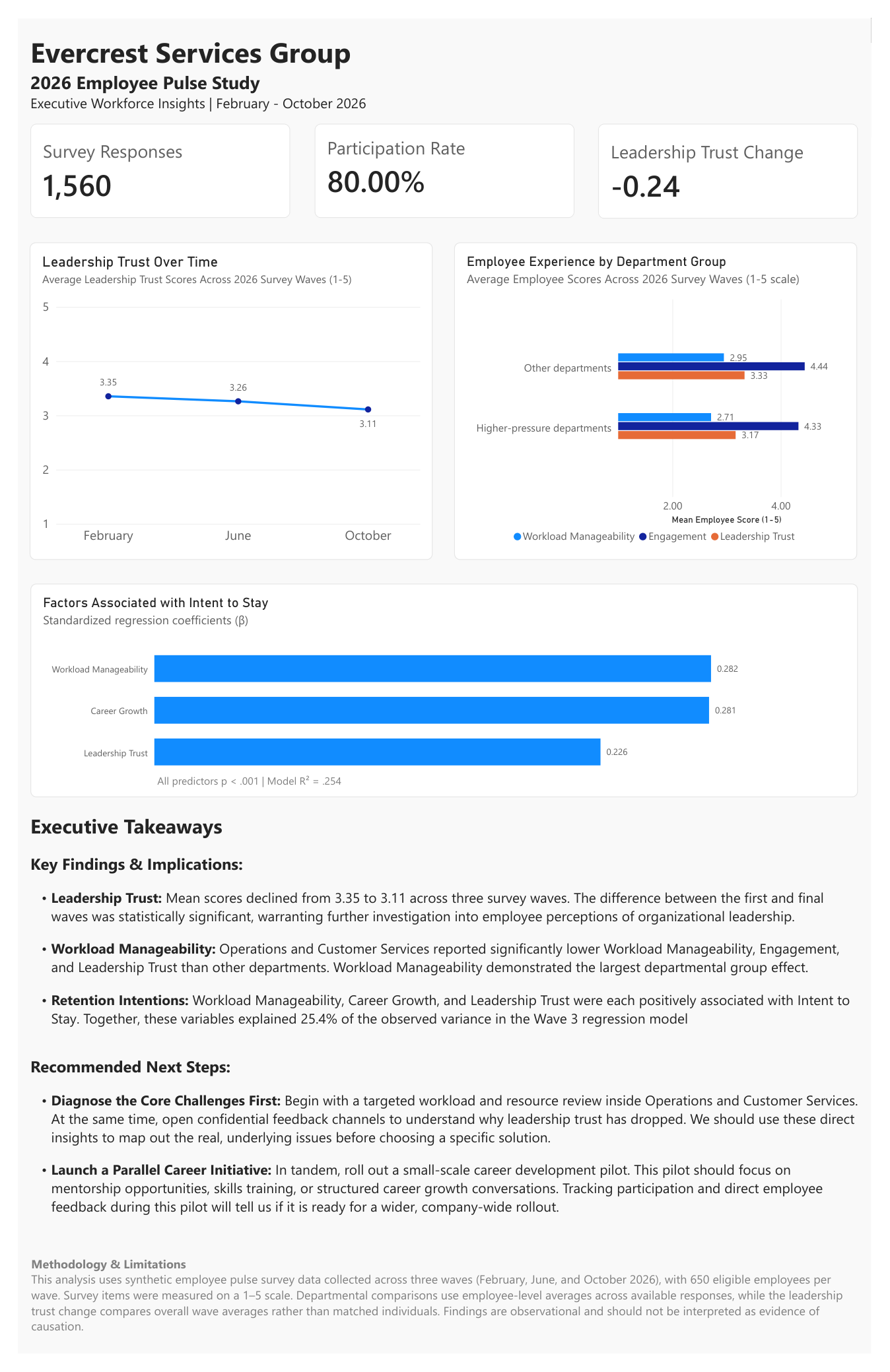
Select the preview to open the full two-page dashboard.
Selected findings
Mean trust fell from 3.35 in Wave 1 to 3.11 in Wave 3; the matched-wave Friedman test was significant (p = .008).
Operations and Customer Services reported lower workload manageability, engagement, and leadership trust than other departments in the grouped comparison.
Workload manageability, career growth, and leadership trust were all positively associated with Intent to Stay in the Wave 3 regression (R² = .254).
Explore the deliverables
Open any of the three completed project deliverables below.
Executive Dashboard
Two-page Power BI overview of survey participation, trends, group comparisons, and statistical findings.
View PDF ↗Full Case Study
Project background, research questions, methodology, findings, and organizational recommendations.
View PDF ↗Technical Appendix
Detailed statistical analyses, diagnostics, methodological decisions, and limitations.
View PDF ↗Reluctant retention & career mobility
Exploring why employees remain in jobs they want to leave, what shapes their perceived options, and how those experiences change over time.
What keeps someone in a job they've already decided they want to leave?
This developing research examines the space between wanting to leave and actually leaving: perceived constraints, familiarity, career transferability, opportunities, and the consequences of staying or moving on.
It considers three perspectives: current reluctant stayers, people who have since left a job they wanted to leave, and satisfied employees as a comparison group.
Qualitative explorationCareer mobilityEmployee experienceWanting to leave and being able to leave are not necessarily the same experience.Guiding idea — not a validated study finding
Early lines of inquiry
These are tentative patterns noted during informal exploratory conversations, not established or generalizable findings.
How comfort with known routines and uncertainty about starting over may influence decisions to stay.
How someone may continue performing their role while their emotional investment in it changes.
How skills, career identity, external opportunities, and practical constraints shape what leaving feels possible.
Where the research could go
Evaluating a personnel selection battery
A demonstration of applied psychometric reasoning: moving from statistical output to decisions about assessment quality and value.
From scores to decisions
Using a simulated dataset, this exercise examined the relationships between selection predictors and job performance, including the unique contribution of an assessment after accounting for other predictors.
Illustrative results from a learning exercise; not evidence from an employer or operational selection system.
Selected standardized coefficients
Multiple regression model predicting simulated performance. Bar length represents the relative positive coefficient.
Additional exercises included reliability, item analysis, model fit, fairness considerations, and interpretation for a nontechnical audience.
Research-minded.
Practice-grounded.
I care about the questions behind the numbers—and what organizations do with the answers.
My background combines industrial/organizational psychology, public-sector human capital consulting, personnel assessment, and project management. I've supported the development and administration of structured selection processes and translated quantitative and qualitative evidence into recommendations for HR teams and organizational leaders.
I'm particularly interested in workforce research, assessment validation, organizational effectiveness, and the employee experiences that aren't always captured by conventional metrics.
Areas of practice
M.P.S., Industrial/Organizational Psychology · B.A., Psychology